
How to hang pictures without nails in a rental
Hanging something on a rented wall splits into two questions. Will it come off cleanly, and can you live with the wall it leaves behind? The second one matters as much as the first, because a patch of filler never quite disappears.
There are four ways to get something on a wall you do not own. They range from completely reversible to reversible in theory. Knowing which is which saves a lot of arguing with your deposit agent later.
Leaning, which leaves nothing at all
Start here, because it is the answer more often than people expect. A ladder shelf, a leaning frame, a full height mirror propped against the wall, a set of hooks over the top of a door. None of these touch the plaster at all.
The trade is floor space and stability. A leaning frame needs a floorboard to lean against or it slides, and dust gathers behind anything angled to the wall. Both are manageable and neither appears on a damage list.
Adhesive hooks, with three conditions
Adhesive hooks are the workhorse of the renter-friendly approach. They work properly on painted masonry, and they fail in predictable ways, all of which are avoidable.
- The wall needs to be painted, not wallpapered. Adhesive bonds to the vinyl top layer of old wallpaper and lifts the whole sheet.
- Wait the full cure time on the packet before you load the hook. Every pack says seven days and almost nobody reads that.
- Take it down slowly, peeling at a low angle rather than pulling straight back, ideally while the wall is slightly warm.
Cheap no-name hooks on a tube of glue are the ones that fail. They are rated for a photograph, not for a mirror, and the rating on the packet is optimistic anyway.
Command strips, and where they stop
These are stronger than most people expect and far stronger than most landlords want. The large ones genuinely hold a picture frame on a masonry wall. What they should not be trusted with is anything over a bed, anything that swings, or anything you would be upset to find on the floor.
The failure mode is worth understanding. Adhesive strips bond across a wide area, and on plasterboard or a textured wall they grip the high points and tear the surface underneath when they let go. On smooth painted plasterboard they are the single most common cause of the peeled-paint deduction.
Picture ledges, which are the honest compromise
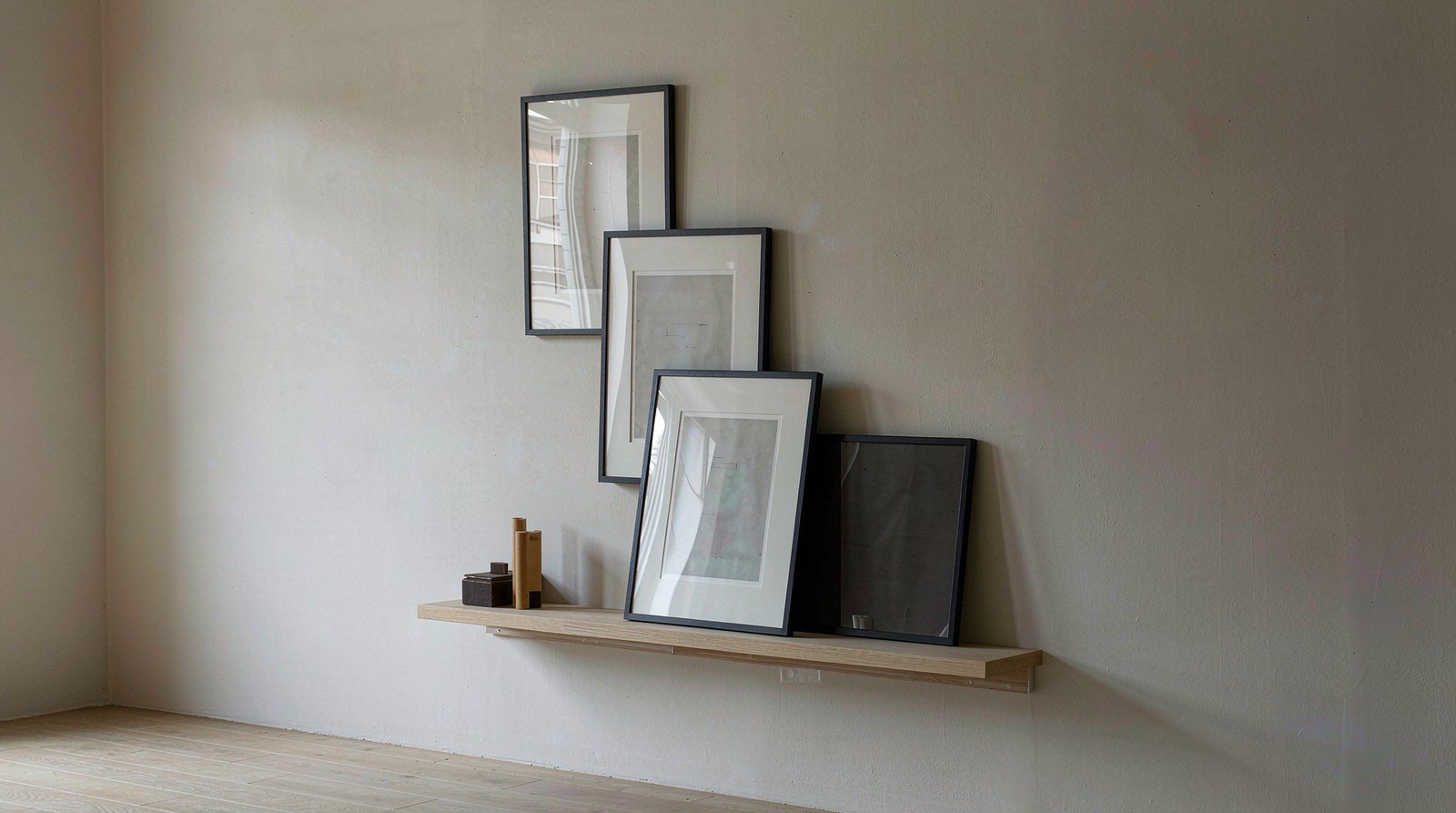
A picture ledge is a long narrow shelf fixed with adhesive strips or removable pads rather than screws. It takes a row of leaning frames, needs one strip per foot of length, and gives you a much tidier result than sticking pictures directly to the wall in a grid you will later regret.
It also lets you rearrange without touching anything. Frames lean against it rather than hanging from it, which means you can swap them whenever you like. In a room you may only have for a year, that flexibility is worth a lot.
What is still not acceptable
Nails, screws, and picture hooks with visible pins are out. So is anything fixed to the skirting boards, the door frames, or the window frames, which are the surfaces landlords check first and are the easiest to damage because they are painted hard gloss.
Also out: anything over a radiator, anything that reduces the gap needed for heat to move, and adhesive in a bathroom. Humidity gets into the glue and softens it, so the strip either lets go suddenly and takes paint with it, or creeps down the wall over a few weeks.
All of that is fine to do in a place you own. It is a short list and worth knowing before you fall in love with something that needs six holes. The deposit guide covers what each of these does when you hand the keys back.
A quick test before you commit
If you are unsure about a wall, find somewhere out of sight and press on it. Dented paint that brushes back means plasterboard. If you can feel a hard edge, that is a seam. Both mean leaning is the safer choice, and leaning always works.